
Young Researcher's Advisory Panel
- Bethan Taylor(PI),
- Camille Warrington(CoI),
- Roismi Rajakumar-Mangrove(Project Member),
- Poppy Baulch(Project Member),
- Megan Elizabeth(Project Member)
Project:
Research
Project status
Active
Description
The Young Researcher's Advisory Panel are a group of young people aged 16-25 passionate about driving youth-led change in the field of child sexual abuse and exploitation. The YRAP exists primarily to ensure that research about young people is informed by and undertaken with young people, including those with lived experience of the issues being explored. We think this is really important for lots of reasons – particularly when research focuses on young people who have already faced marginalisation or silencing from people in power. We want to be part of changing the way knowledge is produced – encouraging policymakers, practitioners and researchers to take young people seriously and see them as active partners in bringing about change.
While there has been much improvement in embedding adult survivor voices within work in the sector, we recognise that children and young people’s voices remain marginalised. We believe this is in direct contradiction to children’s right to participation, enshrined in Article 12 of the UNCRC.
Youth participation has been central to the Safer Young Lives Research Centre since its inception almost two decades ago, with researchers regularly working with young people’s advisory groups on individual research projects and both using and advocating for participatory methodologies. In 2016, the Safer Young Lives Research Centre secured a small pot of funding for a two-year pilot to support young people’s ongoing engagement and influence within the Centre and beyond. The YRAP was set up in partnership with eight young people who had taken part in research with the Centre and had expressed a desire to remain involved.
The YRAP members are involved in research, policy and practice locally, nationally and internationally. They are based across the UK and hold regular online meetings as well as in-person creative sessions.
There are two core strands to the work of the YRAP: sharing lived expertise of harm and sharing learned expertise around participation.
As far as we know, the YRAP is a unique model of enabling young people’s participation in applied research and policy to address sexual abuse.
While there has been much improvement in embedding adult survivor voices within work in the sector, we recognise that children and young people’s voices remain marginalised. We believe this is in direct contradiction to children’s right to participation, enshrined in Article 12 of the UNCRC.
Youth participation has been central to the Safer Young Lives Research Centre since its inception almost two decades ago, with researchers regularly working with young people’s advisory groups on individual research projects and both using and advocating for participatory methodologies. In 2016, the Safer Young Lives Research Centre secured a small pot of funding for a two-year pilot to support young people’s ongoing engagement and influence within the Centre and beyond. The YRAP was set up in partnership with eight young people who had taken part in research with the Centre and had expressed a desire to remain involved.
The YRAP members are involved in research, policy and practice locally, nationally and internationally. They are based across the UK and hold regular online meetings as well as in-person creative sessions.
There are two core strands to the work of the YRAP: sharing lived expertise of harm and sharing learned expertise around participation.
As far as we know, the YRAP is a unique model of enabling young people’s participation in applied research and policy to address sexual abuse.
Project Information
Project Type
Research
Acronym
YRAPTime Period
01/12/2014 – OngoingStatus
ActiveKey Findings
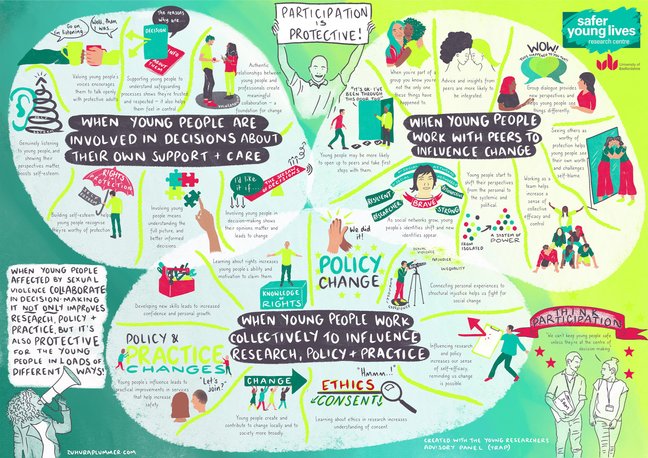
Participation is protective. The right to participation exists for all young people, and is particularly significant for young people often considered to be the 'most vulnerable', such as those who have experienced child sexual abuse, including exploitation.
While there are many universal considerations around child and youth participation, there are specific considerations for participatory work with children and young people on child sexual abuse and exploitation.
Young people tell us that care following childhood sexual violence is currently treated as a privilege, not a right, and that people and systems currently dismiss responsibility for caring for children and young people after disclosure. They have shared with us experiences of receiving responses of indifference, inaction and disbelief, and tell us that care is not neutrality or passivity, it is belief followed by action.
While there are many universal considerations around child and youth participation, there are specific considerations for participatory work with children and young people on child sexual abuse and exploitation.
Young people tell us that care following childhood sexual violence is currently treated as a privilege, not a right, and that people and systems currently dismiss responsibility for caring for children and young people after disclosure. They have shared with us experiences of receiving responses of indifference, inaction and disbelief, and tell us that care is not neutrality or passivity, it is belief followed by action.
Sustainable Development Goals
 SDG 3 Good Health and Well
 SDG 5 Gender Equality
 SDG 10 Reduced Inequalities
 SDG 16 Peace, Justice and Strong Institutions
 SDG 17 Partnerships for the Goals